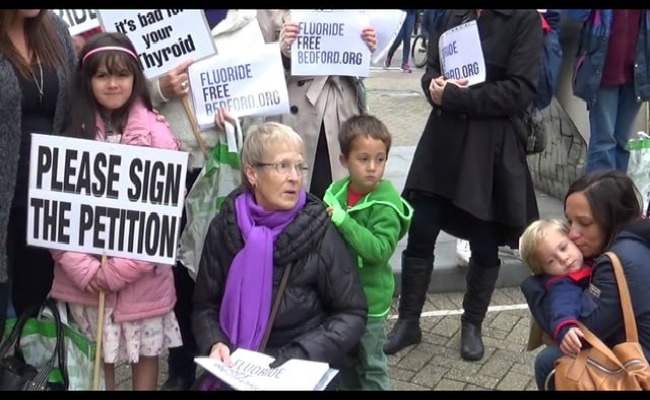
English Town Takes To Streets Against Fluoride In Water

540179460_640

By Brandon Turbeville and Heather Callaghan

The streets of Bedford, England were the scene of an anti-fluoride campaign on Saturday, October 17. Throughout the streets, teams of activists with Fluoride Free Bedford signs were carrying clipboards and information packets to educate and encourage shoppers and passersby as to the dangers of forced water-fluoridation and their petition to stop it.

Fluoride Free Bedford has been calling for an end to water fluoridation since 2002 yet their new impetus for action comes as a newly elected group of councilors have taken office.

Cynthia Bagchi, Fluoride Free Bedford coordinator, stated:

We want to stimulate discussion throughout Bedford and to stun councilors, to show them the huge amount of support there is from people who don’t want fluoride in their water supply.

She also stated:

It’s about educating ourselves and each other. The government isn’t doing it and nor is the counsel, they are just covering up the truth.

The water in Bedford borough had been fluoridated for about 40 years but in 2009 the process was temporarily suspended in order so that improvement and repairs could be made on the area’s water treatment plant. Fluoride Free Bedford is attempting to ensure that fluoride does not return.

The activists are frustrated because in 2011 the Bedford Borough Council voted unanimously to cease water-fluoridation – a proposal that was submitted by major Dave Hodgson. Still, no action was actually taken.

Fluoride Free Bedford is working in coordination with the West Midlands Against Fluoridation group; a similar organization designed to serve the West Midlands area.

Joy Warren, coordinator of WMAF, stated:

The only reason fluoride is added to our water supply is for it to have a physiological effect on the enamel  of the milk teeth of very young children by exerting an effect from the inside of the tooth to the outside. This means that fluoride is a medicine and fluoridated water is, according to a judgement in the European Court of Justice, classified as a “functional food.” A “functional food” is first and foremost a medicine and thus, medicinal law takes precedence over food law. The difference is that pills are legalized medicine whereas fluoridated water is illegal medicine.

To sign Fluoride Free Bedford ‘s petition to end water fluoridation in Bedford Borough, go HERE.

This article (English Town Takes to Streets Against Fluoride in Water) can be republished with original links. You have permission to republish this article under a Creative Commons license with attribution to Brandon Turbeville, Heather Callaghan, the original article and Natural Blaze.com.

Brandon Turbeville – article archive here – is an author out of Florence, South Carolina. He has a Bachelor’s Degree from Francis Marion University and is the author of six books,Codex Alimentarius — The End of Health Freedom, 7 Real Conspiracies, Five Sense Solutions and Dispatches From a Dissident, volume 1 and volume 2, The Road to Damascus: The Anglo-American Assault on Syria, and The Difference it Makes: 36 Reasons Why Hillary Clinton Should Never Be President. Turbeville has published over 600 articles dealing on a wide variety of subjects including health, economics, government corruption, and civil liberties. Brandon Turbeville’s podcast Truth on The Tracks can be found every Monday night 9 pm EST at UCYTV. He is available for radio and TV interviews. Please contact activistpost (at) gmail.com.

Heather Callaghan is a natural health researcher. You can see her work at NaturalBlaze.com. Like at Facebook.

Falling in Love: Is It Just Another Chemical Addiction?

By Gina Flores

Editor at NoFakeNews

It’s been widely speculated for a longtime that the feelings and emotions connected with “falling in love” are really just a product of chemicals being produced inside the human brain and other parts of the nervous system. Now scientists have performed research that seems to support this idea. According to science, the chemicals and neurotransmitters that are released in the human body when people believe they are in love are actually more addicting in nature than heroin and cocaine.

Read more here!  

Has Russia Uncovered the Real Terrorists?

By Gina Flores

Editor at NoFakeNews

In a very short period of time it seems as if Russia has uncovered the real terrorists in the world. According to Preston James, PhD, “…as a result of some of the most brilliant geopolitical maneuvering in history, Russian Federation President Vladimir Putin has created a complete checkmate in Syria. This checkmate has completely exposed the USA, CIA, Israel, Saudi Arabia and Turkey for creating, training, financing and supporting ISIS, ISIL, Daesh, Al Qaeda and the rest of these Mideast Terrorist groups.”

What Preston writes about on his blog has been widely echoed by many alternative news writers for a very longtime. It’s obvious to those that have removed the blinders from their eyes that the bankers are calling the shots, financing wars and using powerful governments to acquire natural resources and other precious assets from around the world.

Read more by clicking here!

What’s Really Going On in Syria

By Dr. John L. Reizer

Editor at NoFakeNews.net

Does anybody really believe that the mass bombing of Syria by the United States, Russia and others has anything to do with the oppression of the Syrian people? Is there something else that is really in play here? Are we in fact watching the beginning of a third world war that has intentionally been planned well in advance?

For more details, watch the latest David Icke video-cast trailer below:

How do libraries get away with banning books?

Clay Calvert, University of Florida

A dozen years ago, in his New York Times review of the best-selling British novel The Curious Incident of the Dog in the Night-Time, Jay McInerney (of Bright Lights, Big City fame) called it “stark, funny and original.” Told from the perspective of a 15-year-old autistic savant, the book is now a Tony Award-winning play.

But what’s hot on Broadway is sometimes too hot for Florida Panhandle high schools.

This past summer, the novel was pulled from the assigned summer reading list at Lincoln High School in Tallahassee, Florida. As reported by the Tallahassee Democrat, “the move was made to accommodate offended parents,” who apparently took offense to the dozens of instances of profanity in the text.

Whether it’s challenging Harry Potter books for promoting Satanism and the occult or wiping Fifty Shades of Grey from the shelves for depicting “mommy porn,”, it’s become all too common for books to be challenged – and sometimes banished – from local libraries and schools.

The American Library Association’s annual Banned Books Week, currently in its 23rd year, officially celebrates and promotes “the freedom to read” by raising awareness of books that are most frequently challenged across the nation.

Perhaps more significantly, however, Banned Books Week also provides both a rudimentary barometer of contemporary cultural concerns – the flashpoint topics, ideas and words that push our censorial buttons – and a test of our core commitment to the First Amendment.

Beware the parental penguins

The challenged books let us take the pulse of American squeamishness and, more bluntly, intolerance. They reveal the concerns of the day that rub some people the wrong way, so much so that they take the time and effort to file complaints rather just averting their eyes or cautioning their own children.

Not surprisingly, sex and sexuality, along with religion, are hot-button topics. Number three, for instance, on OIF’s list of most challenged books for 2014 is And Tango Makes Three. The children’s book, which was inspired by actual events in New York’s Central Park Zoo, tells the story of two male penguins who hatch and raise a female penguin named Tango. Publishers Weekly called it a “heartwarming tale.”

And Tango Makes Three was banned in a number of libraries across the country.
jessica wilson/flickr, CC BY-NC-ND

Those challenging it, however, find it anything but heartwarming. Instead, it is “anti-family” and “promotes the homosexual agenda.” Then again, at least the book was not the most challenged this past year, as it was in 2006, 2007, 2008 and 2010 (the 2014 honor goes to Sherman Alexie’s The Absolutely True Diary of a Part-Time Indian).

Culturally, the wrath heaped upon And Tango Makes Three suggests that one recent Supreme Court ruling aside, we are still conflicted when it comes to same-sex marriage (apparently for both humans and penguins).

Into the courtroom

Cultural questions, of course, sometimes spill into courtrooms. While the First Amendment explicitly protects freedom of speech, it also implicitly safeguards our right to receive speech.

As Justice William O Douglas wrote for the US Supreme Court fifty years ago in Griswold v Connecticut, “the right of freedom of speech and press includes not only the right to utter or to print, but the right to distribute, the right to receive, the right to read and freedom of inquiry.”

Griswold’s logic leads to convoluted case law surrounding public schools’ ability to regulate and ban books in their libraries.

In a 1982 case called Board of Education, Island Trees Union Free School District v Pico, a New York school district sought to remove a number of books from library shelves, including Kurt Vonnegut’s Slaughterhouse Five, Eldridge Cleaver’s Soul on Ice and a Langston Hughes-edited collection called Best Short Stories of Negro Writers.

According to the school board, the titles removed were “anti-American, anti-Christian, anti-[Semitic], and just plain filthy.”

A fractured Supreme Court wrote that “the discretion of the States and local school boards in matters of education must be exercised in a manner that comports with the transcendent imperatives of the First Amendment.”

In other words, school boards have discretion to pick and choose books, but that discretion is confined by minors’ rights to receive a wide swath of ideas and information, not just conformist doctrine.

US Supreme Court Justice William Brennan wrote that schools couldn’t ban books ‘in a narrowly partison or political manner.’
Library of Congress

The court added that “just as access to ideas makes it possible for citizens generally to exercise their rights of free speech and press in a meaningful manner, such access prepares students for active and effective participation in the pluralistic, often contentious society.”

Lofty rhetoric aside, Justice William Brennan cobbled together a few rules that remain in place today: schools may not exercise their discretion “in a narrowly partisan or political manner,” and they “may not remove books from school library shelves simply because they dislike the ideas contained in those books.”

The court concluded there was enough evidence to suggest the school district’s reasons for removal violated the principles noted above, and it denied the board’s motion to have the case tossed out.

Indeed, the ALA makes it clear that despite a constant drumbeat to pull books from the shelves, “most challenges are unsuccessful and most materials are retained in the school curriculum or library collection.”

Of course, a few challenges do result in bans.

Ultimately, the problem of book banning and challenging won’t go away. Public libraries and schools with limited budgets must make tough calls on what to buy, remove or put behind the check-out desk. Their choices tell us much about where we stand culturally, while their willingness (for the most part) to combat challenges reflects their unwavering commitment to free expression.

The Conversation

Clay Calvert, Brechner Eminent Scholar in Mass Communication, University of Florida

This article was originally published on The Conversation. Read the original article.