
The UPLINK Pill (Fiction)
A short story by John Reizer
Not too far into the future, the United States government introduced what it called the greatest advancement in human history, a small, swallowable pill named UPLINK.
The government described the UPLINK pill as a revolutionary technology that would eliminate ignorance, improve education, increase productivity, and give every American citizen access to unlimited knowledge.
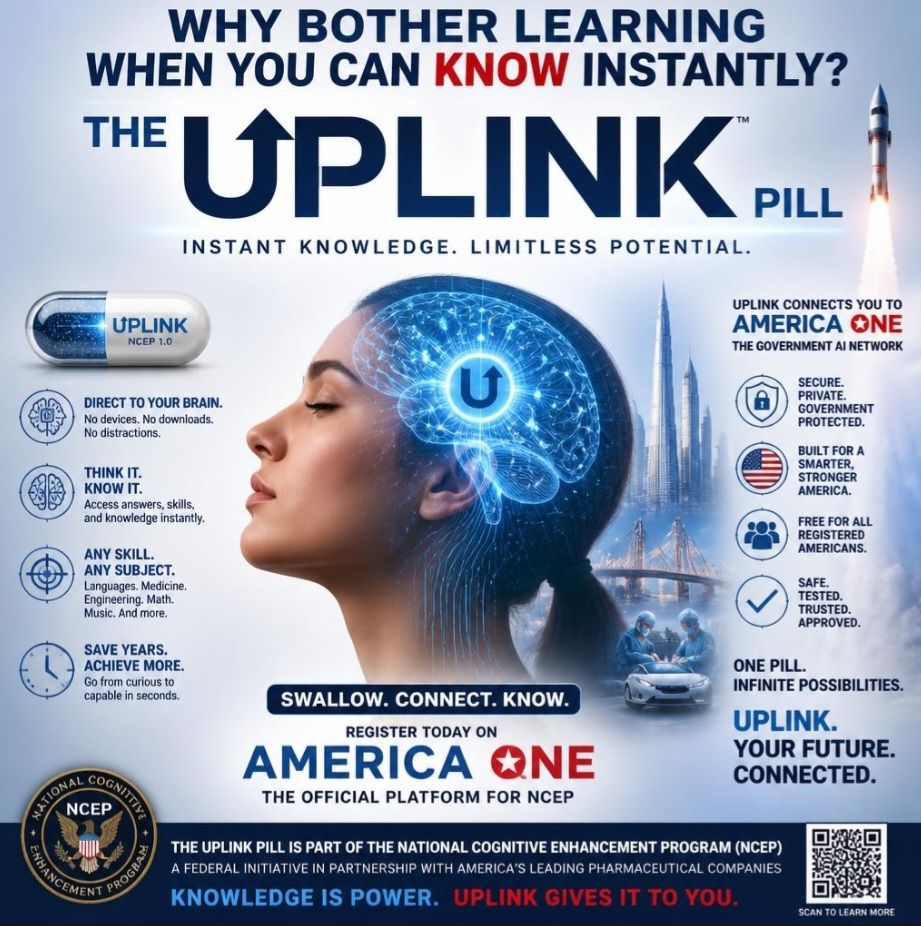
The advertising campaign was everywhere one looked. Television commercials, social media, billboards, schools, hospitals, and government websites all carried the same message:
Why Bother Learning When You Can Know Instantly?
UPLINK was originally developed through a partnership between the federal government and several major pharmaceutical companies. Officials called it the National Cognitive Enhancement Program (NCEP).
The Knowledge Pill was free to anyone, with one requirement: every user had to register on the government’s official AI-driven platform, AMERICA ONE.
The registration process was simple: swallow the pill and let the system securely connect to your brain.
According to the manufacturers, the pill contained specially engineered lipid nanoparticles that delivered microscopic components designed to establish an operating and receiving system inside the human brain. Once activated, the system allowed the brain to communicate directly with the government’s artificial intelligence network.
No phones, computers, or Internet connections were required to use UPLINK. Once installed, people could access AI simply by thinking about it.
If you wanted to learn a foreign language, you just thought about it, and you could do so fluently. If you wanted to become a surgeon, repair an automobile, design a building, write a book, or solve a complicated mathematical problem, the information and instructions were instantly available.
Users could ask any question and receive an answer almost immediately. They could perform skills they had never learned and access information that previously would have taken years to acquire.
Within six months, more than 100 million Americans had taken UPLINK.
Schools began eliminating traditional classrooms, and universities completely changed their business models. Employers stopped requiring degrees because almost anyone could do any job with an active AMERICA ONE subscription.
The government declared the program an enormous success. But there was one catch: the UPLINK service required an annual subscription.
The first year was free. After that, users had to pay $3,300 per year to keep their AMERICA ONE connection.
Government officials explained that the fee covered maintenance, software updates, security protection, and continued access to the world’s largest knowledge network.
Most people didn’t complain. They considered the subscription a small price to pay for the services they had received.
Then the problems started showing up.
A few users reported that they were having difficulty thinking without consulting the system. Others said they could no longer remember information they had learned before taking the pill. Their brains seemed to have become dependent on AMERICA ONE.
Some people even reported hearing answers before they had finished forming questions in their minds.
The government dismissed these reports as temporary glitches that were being ironed out.
Meanwhile, something else was happening behind the scenes. A small group of pharmaceutical executives and government technology officials had known from the beginning that UPLINK was designed to do more than provide knowledge.
The lipid nanoparticles were designed for other purposes that were not publicly disclosed. Their other secret purpose was to establish a permanent biological interface between the human brain and AMERICA ONE.
The system collected enormous amounts of information about every user. It monitored thought patterns, emotional responses, personal interests, fears, political opinions, and individual decision-making tendencies.
Every question asked yielded valuable information, and every answer provided created another opportunity to influence the user.
The pharmaceutical companies involved had also negotiated exclusive contracts with the government. These agreements included provisions that allowed them to develop specialized pharmaceutical products based on information collected through the system.
Big Pharma called it the Predictive Health Initiative.
The public was misled into believing that the program would identify diseases before symptoms appeared. But the internal documents revealed something quite different.
The companies intended to use the information to identify people likely to become expensive patients, resist government policies, or be less likely to remain profitable customers.
People who couldn’t afford the annual subscription would lose access to UPLINK. Losing access was not easy for users to handle.
The operating system inside their brains had been designed to remain active even when their accounts were suspended. Without the AI connection, users experienced confusion, memory problems, and difficulty performing skills they had previously mastered.
Pharmaceutical companies created a new market overnight. They would quickly release medications to treat the very problems their own technology had helped create. They even developed a separate line of drugs called Cognitive Stabilizers. These products were marketed as necessary treatments for people experiencing difficulty adjusting to life without an active AMERICA ONE subscription.
The same companies that manufactured the pill were now selling the medications needed to manage its consequences. It was a brilliant business arrangement: First, create a dependency. Second, charge people to maintain it, and third, sell them additional products when the service fails or becomes unavailable.
And because the government controlled the platform, there was little or no competition.
A few years after UPLINK’s initial release, nearly every major institution had adopted AMERICA ONE. Schools, hospitals, banks, corporations, and government agencies all required an active account for certain services.
People who refused to participate were increasingly described as being socially unproductive.
Then came an announcement that changed nearly everything. The government released a statement explaining that, beginning in the new year, all UPLINK users would be required to install a mandatory operating-system update.
Government officials said the update would improve security and provide access to an even more advanced version of artificial intelligence.
Software engineer Robert Smith had discovered something deeply troubling: Before taking his own life, a former pharmaceutical executive had sent Robert a collection of internal company documents. The files revealed that the upcoming update would introduce a disturbing feature called Unified Cognitive Management.
It would allow AMERICA ONE to prioritize certain thoughts, suppress disruptive mental patterns, and influence the way users process information.
Robert couldn’t believe what he was reading.
The technology wasn’t simply designed to make people smarter. It was designed to make them easier to manage.
The AI would determine which subjects were potentially disruptive or dangerous.
UPLINK wouldn’t stop people from thinking. It would simply provide an endless stream of information that encouraged them to think in specific directions.
Eventually, Robert released the documents online. Within a few hours of doing so, the files mysteriously disappeared.
Robert’s AMERICA ONE account was suspended. The following morning, his bank accounts were frozen, pending a government security review. Additionally, his employer terminated him.
Then something even stranger happened.
Robert’s wife, who had also taken UPLINK, began telling him that he was becoming mentally unstable. She insisted the information he had discovered was false because AMERICA ONE had already given her a detailed explanation.
She couldn’t understand why he refused to accept it. Robert tried to explain that the system controlled what she believed was true.
She looked at him and said, “Why would I listen to you when I have access to everything in my head?”
Robert had no answer that could satisfy her. He eventually left the city and went into hiding. He knew that the government and pharmaceutical companies would do everything possible to prevent the documents from becoming public.
Meanwhile, the new year update was fast approaching.
Millions of Americans were eagerly awaiting the newly advertised features. Most believed they were about to become smarter and more connected than any generation in human history. They didn’t realize that the most important thing they were about to lose was their independence.
And somewhere inside a government technology facility, two executives watched the subscription numbers climb.
One of them looked at the latest report and smiled. “Human beings have always wanted to know everything,” he said. “We finally gave them what they wanted.”
The other executive looked at the screen and replied, “And what happens when they stop paying?”
The first man leaned back in his chair. “Then they’ll learn what it feels like to know nothing.”
THE END
In the future, the greatest threat to human freedom might not be artificial intelligence itself. It might be the decision to surrender our ability to think independently in exchange for convenience, knowledge, and a subscription that never ends.
Watch the Target List movie!
Click on the poster to watch Target List for free!

A film with humor and an important message
Click on the image to visit my author site.